



NEWS&EVENTS
Home > News&Events > Company news > The Core Electrolytic Reaction Equipment for the Copper Electrolytic Refining Process
Electrolytic copper refining is a critical process for purifying crude copper into high-purity cathode copper. Its core equipment comprises the electrolytic cell, cathode system, anode system, and conductive apparatus; these four components work in concert to facilitate the directional migration and deposition of copper ions.
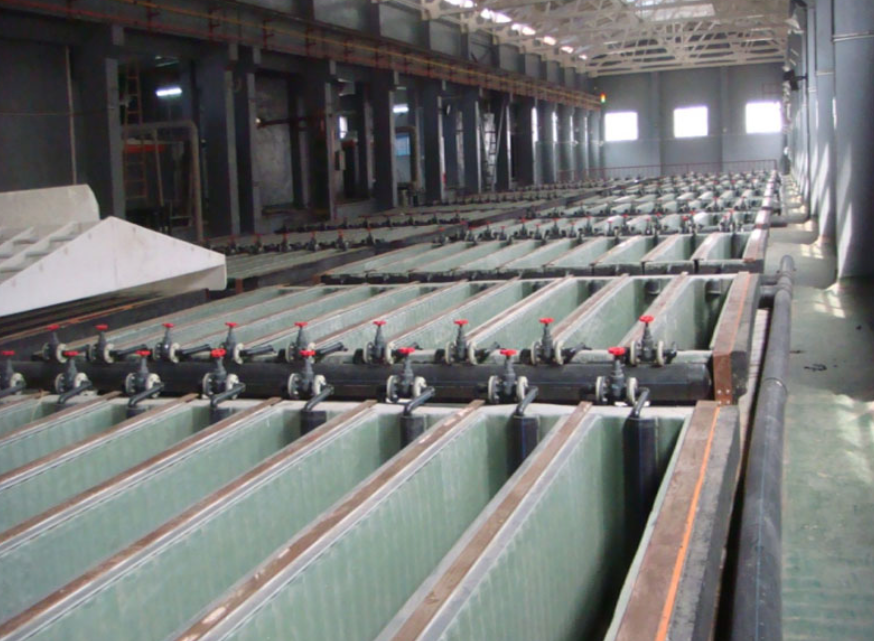
The electrolytic cell serves as the primary vessel for the electrochemical reaction. Typically a rectangular tank lined with corrosion-resistant materials, it houses the electrolyte, anode plates, and cathode plates. Its design dimensions, electrode spacing, and circulation system layout significantly influence current distribution and production efficiency; in industrial operations, multiple electrolytic cells are typically grouped together in series or parallel configurations.
The cathode system acts as the substrate for the reductive deposition of copper ions. Modern large-scale copper smelters increasingly utilize permanent stainless steel cathode plates to replace traditional starter sheets; these plates feature superior flatness, require infrequent replacement, and facilitate higher levels of automation. Complementary insulating edge strips are installed along the sides of the cathode plates to precisely delineate the deposition zone, thereby ensuring that the resulting cathode copper possesses a smooth and dense surface finish.
The anode system consists of anode plates cast from crude copper. Under the influence of direct current, copper atoms lose electrons to form copper ions, which then dissolve into the electrolyte solution; simultaneously, more reactive impurities also dissolve, while precious metals and other inert substances settle to the bottom as "anode slime," which can subsequently be recovered. The quality of the anode plates directly impacts both the electrolytic efficiency and the effectiveness of the anode slime sedimentation process.
The conductive apparatus supplies the system with a stable source of direct current. Through robust connections—typically established via busbars—to both the anodes and cathodes, this apparatus ensures uniform current density, minimizes contact resistance and energy loss, and prevents localized overheating or short circuits.
In summary, these four major components operate in close coordination: the electrolytic cell provides the reaction environment; the anodes and cathodes execute the dissolution and deposition of copper, respectively; and the conductive apparatus drives the migration of ions. Together, they transform crude copper into cathode copper with a purity of ≥99.99%, while simultaneously concentrating precious metals within the anode slime.